
Kerf Modulators
MSEG and LFO
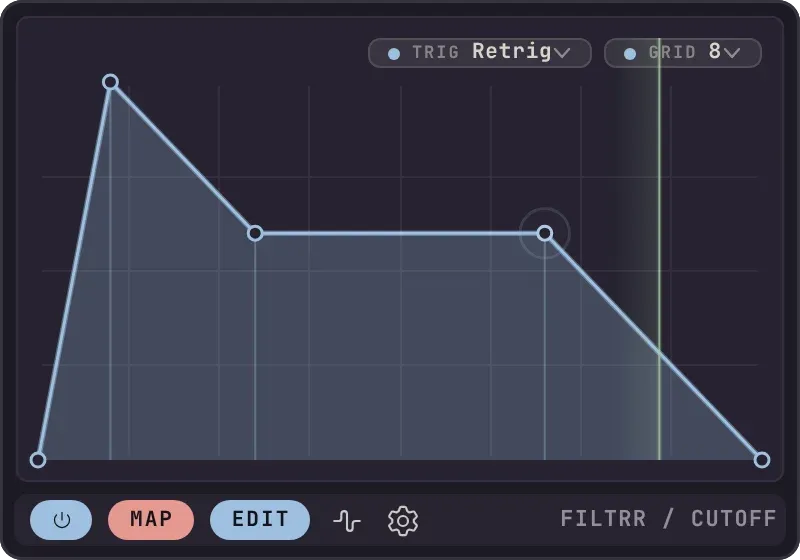
The MSEG editor, retriggered, on an eight-step grid.
A multi-segment envelope you draw yourself. Add as many nodes as you need, give each segment its own shape, and run it looped or as a one-shot, free or locked to the grid.
Double-click the canvas to add a node, drag to move it, double-click a node to remove it. The curve button cycles the selected segment through Linear, Ease, Exponential and Hold. Drag a node onto its neighbour and the two snap to the same time, for a truly vertical edge.
| Control | What it does |
|---|---|
| Retrig | Restarts on play, at clip starts and at the loop point. |
| Free | Runs continuously and ignores the transport. |
| 1-Shot | Plays once each time the transport starts, then holds its last value. |
| Length | How long one cycle lasts, as a value and a unit on the editor face: minutes, seconds, milliseconds, bars (following the project’s time signature), or straight, dotted and triplet notes from 1/2 to 1/32. A new MSEG starts at 1.0 bar. |
| Delay | Offsets the start of the cycle, in beats. |
| Depth | Scales the output without moving your nodes. |
| Grid | Off, 4, 8, 16 or 32 divisions, with node snapping. |
| Loop section | Cycles part of the curve rather than all of it. |
| Jitter | Random wobble on the value, the timing, or both. |
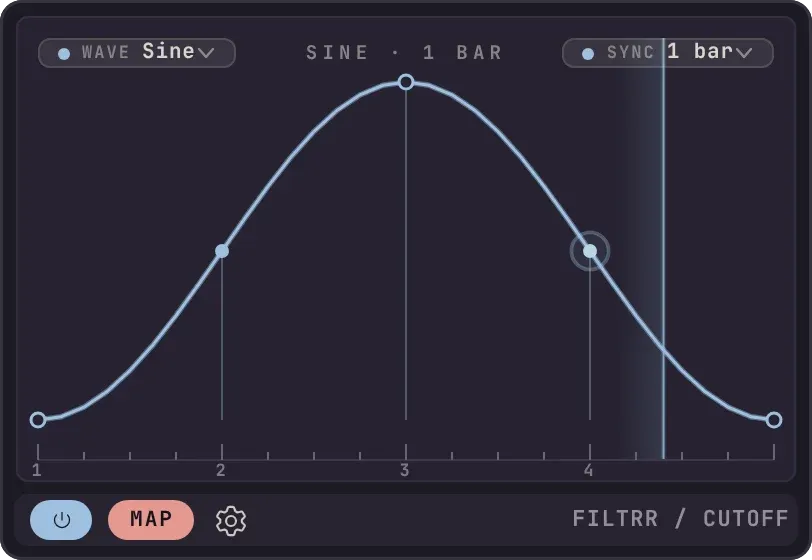
The LFO, a sine synced to one bar.
Sine, triangle, saw and square, plus random (sample and hold) and Perlin, a smooth drifting noise. Run it in hertz or locked to the project tempo, with depth, phase and jitter.
Retrigger resets the phase on loops and seeks, so a take sounds the same on every pass. Free run keeps going regardless, for movement that should feel independent of the edit.